The Walker family’s curse-cleansing furniture-moving ritual
The Sky Is EverywhereThe Walker family’s curse-cleansing furniture-moving ritual is Gram’s improvised attempt to drive bad luck out of the Walkers’ house by moving its contents outside, burning sage, and refusing to bring anything deemed unlucky back in. What begins as a household-wide response to misfortune becomes an unexpectedly revealing encounter: Joe Fontaine arrives to help, Toby Shaw is present as Bailey’s boyfriend, and Lennie Walker’s unresolved attraction to Toby becomes visible to Joe. The ritual cannot settle the family’s grief, but it gives uncertainty a set of physical actions—and places the family’s hidden tensions in a room together.
Origins and Intended Procedure
The ritual begins with Gram’s conviction that the family’s terrible luck may have a cause lodged in the house. She says the idea came to her in the middle of the night and proposes a practical sequence with a supernatural logic: move suspicious possessions outdoors, perform a ritual, burn sage, and keep anything unlucky from returning inside. The evidence does not identify a particular object as the source of misfortune; the plan instead treats the house and its contents as a whole that can be temporarily emptied, examined, and reset.
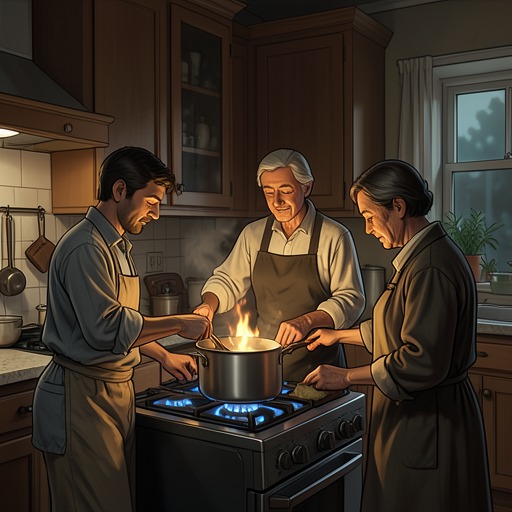
When Lennie approaches the house, the attempt is already underway. Books, furniture, masks, pots and pans, boxes, antiques, paintings, dishes, and knickknacks have been stacked in the front yard. The familiar domestic interior has been displaced into the open, making Gram’s private theory of bad luck visible as an unusually literal upheaval. Joe and a brother who is broader and taller than he is carry the sofa out of the house, while Joe asks Gram where she wants it placed. His matter-of-fact participation makes the extraordinary plan look, for a moment, like ordinary moving-day work.
Gram explains that Joe went to fetch his brother to help. Her explanation combines household labor and ritual: the family is not merely rearranging furniture but trying to identify and remove whatever might be bringing them harm. Lennie, by contrast, registers the strangeness of the plan and wishes she could have seen Joe’s reaction when Gram described it. Her dry response sets her skepticism beside Gram’s earnest purpose without stopping the ritual from proceeding.
The House Turned Inside Out
By the time Lennie returns from the woods with Joe, Toby’s truck is parked outside. The sight has an immediate bodily effect on her; she slows down and separates herself from Joe, while her stomach churns as they approach the house. She considers retreating into the woods rather than entering a room with both young men, but knows she cannot convincingly stage another breakdown. The ritual has brought the people she would prefer to keep apart into the same space, and there is no easy way to avoid that fact.
Inside, the room has been altered from a house into a ceremony. Candles give it a glow, sage thickens the air with its sweet scent, and DougFred and Marcus play flamenco guitar from two of the remaining chairs. The portrait called The Half Mom hangs above them as the fiery chords fill the room. Uncle Big stands by the mantel, clapping his hand against his thigh in time. The furniture-moving plan has not made the house quiet or empty; it has made room for music, smoke, and a gathering of family and visitors.
Toby stands apart from the others by the window. In the flickering light, Lennie sees him watching her with an intensity she knows Joe notices. She feels an almost irresistible pull toward Toby even though Joe is beside her, and imagines that she might cross the room to him. The image of an invisible rope gives physical form to a conflict she cannot explain away: her attachment to Joe and her grief do not erase her attraction to her sister’s boyfriend. The ritual’s stated task is to remove unlucky things from the house, but the room instead makes an unspoken emotional entanglement harder to conceal.
Joe, Toby, and What the Ceremony Exposes
Joe’s response changes as he takes in the scene. He asks Lennie who Toby is, without the calm that usually marks his manner. Lennie gives Toby’s name, but the answer does not explain the tension Joe can see. The guitar music briefly catches Joe’s attention: he drums on his thigh and bobs his head as he watches his brothers play, smiling at their performance. Lennie recognizes how intensely he wants his guitar, even as she senses Toby wanting her. For a moment, the music offers movement and shared pleasure; it does not resolve the competing attachments gathered in the room.
The two men notice one another looking at Lennie, and then both look back to her. Joe touches her arm, while Toby’s eyes flare at the gesture. Toby’s attention seems to claim an intimacy that his public relationship to Lennie cannot account for. Lennie’s prior physical closeness with him has not been spoken aloud to Joe, but their glances and reactions make the concealed connection legible. The revelation occurs through posture, gaze, and the charged space between people rather than through a confession.
Gram then enters carrying a burning stick of sage and introduces Joe to Toby as Bailey’s boyfriend. That identification gives Joe an explanation for Toby’s presence, and Lennie sees relief pass over him; he apologizes to Toby. But the introduction also sharpens the irony of the moment. Joe now knows Toby as Bailey’s boyfriend, while Lennie knows that she and Toby have crossed a boundary under the pressure of their shared bereavement. The ceremony has not brought that history into words, yet Joe’s bewilderment and Toby’s intensity have exposed its outline.
The Ritual’s Place in the Family’s Grief
The attempted cleansing is one of several moments in which the family gives grief a physical form rather than treating it as something that can be kept safely inside. Later, Gram rejects the consolation that Bailey lives on in the hearts of those who loved her: she wants Bailey in the kitchen, at the river with Toby and their baby, and acting in plays. Lennie joins her in cutting up Wuthering Heights with garden shears, a book marked by years of reading and association with the river and summer. Their shared act turns anger, loss, and frustration into movement and torn pages. It is not the same ritual as moving the furniture, but it echoes its refusal to leave pain untouched and invisible.
Lennie’s first visit to Bailey’s grave likewise makes remembrance concrete. She runs through alternating patches of sunlight and shade before reaching the small hilltop cemetery, where she sits against the warm gravestone near the sound of the falls. She places a notebook of Gram’s letters to their mother in the stone’s little cabinet and discovers an orange-topaz ring that Toby must have had made for Bailey. After kissing the ring and returning it beside the notebook, Lennie takes her decrepit houseplant to the edge above the falls, removes it from its pot, and throws it away. These later gestures do not show that Gram’s attempt to cleanse the house succeeded; they show grief continuing to demand acts, objects, and places through which it can be faced.
The furniture-moving ritual therefore matters less as a solution than as a communal improvisation. Gram tries to make misfortune manageable by emptying and cleansing the house; the gathering instead brings the family’s losses and Lennie’s divided loyalties into sharper view. The ritual rearranges the rooms, but it cannot rearrange the past. Its candles, sage, displaced possessions, and music give the family a shared scene in which that limit—and the bonds still holding them together—becomes visible.